

Intense Workout
- Upper Body Emphasis -


WORKOUT SUMMARY (+ CLICK TO ENLARGE)
SEE BELOW FOR YOUR DETAILED WORKOUT WALKTHROUGH


| EXERCISE | SUPERSET | SETS | REPS | REST | RPE | EI |
|---|---|---|---|---|---|---|
| Modified Drop Set Single Arm Row | #1,#2,#3 | 3 | 15" hold + 5-6 reps per side (See Video & Notes) | 60-90" | 8-9 | 15" + 2-3" |
Read About Exercise
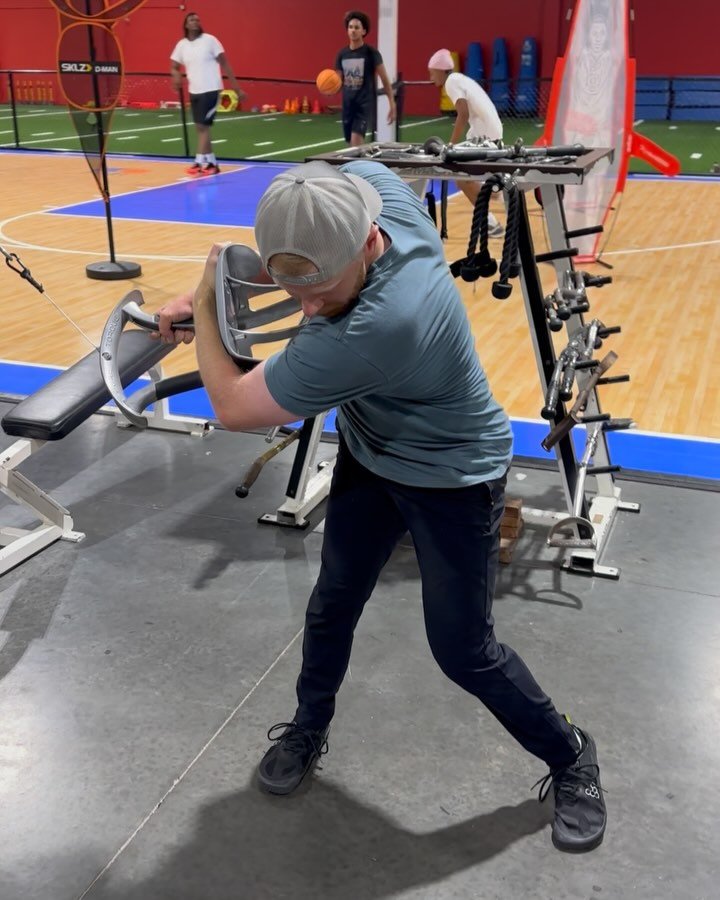
This first exercise is a unique modified drop set on single arm cable rows which his a very effective strength & hypertrophy exercise for the upper back. The first half of the set involves a simple supramaximal eccentric hold (30-40% more weight than his max).
The seated cable row is very conducive for this as the movement starts in the stretched position to begin with therefore it simply requires the athlete to set their spine, shoulder blades, and core then hold the position with the arms full extended. The supramaximal loading creates heightened levels of mechanical tension and muscle damage for maximal muscle growth. You'll literally feel every muscle in your upper back, lats, rear delts, forearms and even your core as you’re resisting rotation while holding a brutal isometric contraction.
Immediately follow this with a drop set by decreasing the load by at least 40% then blasting out smooth rows with additional pauses in the contracted position and brief eccentric isometrics in the stretched position. Because the nervous system will be hyper-activated from the prior heavy loading with max effort isometric, the reduced weight for the standard rows will allow the lifter to produce smooth yet powerful and intense contraction throughout the lats and upper back as the weight will feel inordinately light. As a result this creates further metabolic stress and cellular swelling to the back musculature making it highly effective for producing functional strength and hypertrophy in the upper back as well as other supporting muscles.
On a side note, the single arm version shown here there will actually be a slight amount of rotation. In fact, in the past I’ve mainly used the double arm version for this movement however I’ve noticed after playing around with the single arm version because of the slight rotational position of the upper torso this creates a larger natural stretch of the upper back and lats which could be an added hypertrophy stimulus.
Additionally, the low back tends to not fatigue as quickly as it does during the double arm version.

| EXERCISE | SUPERSET | SETS | REPS | REST | RPE | EI |
|---|---|---|---|---|---|---|
| BANA 2:1 Incline Dumbbell Press | #1,#2,#3 | 3 | 4 per side | 60-90" | 8-9 | 2" |
Read About Exercise
The 2:1 eccentric accentuated protocol also known as the bilateral assisted negative accentuated training protocol (BANA) is one of my favorite eccentric overload methods. Not only does it produce incredible gains in functional strength and hypertrophy but it’s also very effective for targeting each limb individually during the eccentric portion of the lift. Essentially what you’re doing is perform the concentric phase of the lift with 2 limbs and the eccentric phase with 1 limb thereby providing greater eccentric overload during that eccentric or negative movement.
Unfortunately, this technique is often limited to machines or cable systems such as seated machine rows, lat pulldowns, leg extensions, leg curls, chest press machines or other variable resistance pieces of equipment thereby limiting the degree of stabilization and motor control. However, this same concept can be applied to dumbbell chest presses as I show in the video using the incline press. The most weight I typically handle on incline dumbbell presses is 100’s. In addition, for the single arm variations (which tend to be a bit more difficult and demanding) that number is typically closer to 90 pounds.
By using this 2:1 BANA method I’m able to handle a 110 pound dumbbell thereby providing greater overload to the upper body. Additionally, the level of core activation is inordinately high as the degree of anti-rotation and rotary stability needed to control your body under such extreme unilateral offset positions is near maximal effort. In other words, during the eccentric phase it feels as though your body wants to rotate and flip off the side of the bench. And in case you were wondering, yes females can do this without chest discomfort as shown by my awesome athlete Leslie Petch in the second half of the video.

| EXERCISE | SUPERSET | SETS | REPS | REST | RPE | EI |
|---|---|---|---|---|---|---|
| Lunge Pallof Press | #1,#2,#3 | 3 | 4 reps in each of the 4 positions | 60" | 6 | 2-3" |
Read About Exercise
This next exercise is a split squat lunge Pallof Press with a rope. Besides being an incredible core stabilization drill that involves high levels of anti-rotation (i.e. rotary stability) it also targets the smaller stabilizers of the hips and lower leg.
For instance the first several reps Austin performs with his right leg in front and the anchor point to the left of his body requires him to resist medial/valgus forces that are attempting to push his knee and ankle into valgus collapse. In other words it’s an anti-valgus exercise working the outer hip and glute medius. In contrast, when his left leg comes to the front (with the cam still to his left) he’s resisting varus/lateral forces. To maintain balance he’s having to fire his adductors as well as his big toes. In fact both variations crush the smaller stabilizers of the feet & ankles.

| EXERCISE | SUPERSET | SETS | REPS | REST | RPE | EI |
|---|---|---|---|---|---|---|
| Eccentric Overload Pullups with Knee Flexion Loading | #4 & #5 | 3 | 3-4 | 60-90" | 8-9 | 2" |
Read About Exercise
The same partner assisted eccentric potentiation protocol discussed above for eccentric overload pullups can also be performed on pullups as 2 of my NFL athletes Marquell Beckwith and Marcelis Branch demonstrate here. Although there are a few ways to accomplish this I’ve found that the knee flexion method using a plate placed onto the back of the legs/calves is the most conducive for loading and deloading the weight each repetition.
Besides crushing the lats, upper back, and biceps with supramaximal loading these also torch the hamstrings making these a brutally effective functional strength and hypertrophy exercise for the entire posterior chain. Don’t be surprised if the first few reps the lifter experiences greater power output and strength than normal on the concentric phase due to the hyper-activation and potentiation response produced from the supramaximal negative phase. Read more HERE.

| EXERCISE | SUPERSET | SETS | REPS | REST | RPE | EI |
|---|---|---|---|---|---|---|
| BANA 2:1 Smith Machine Overhead Press | #4 & #5 | 3 | 3-4 | 60-90" | 8-9 | 2" |
Read About Exercise
If you're looking for a way to shock your upper body and build new levels of functional strength and hypertrophy in the chest, back, shoulders, and arms, look no further than this eccentric accentuated training method. I refer to this as the 2:1 bilateral assisted negative accentuated training protocol (up with 2 down with 1 method). It can be used on chest presses, rows, shoulder presses, upright rows, squats, and more.
Let's face it, the Smith machine often gets a bad rap in the fitness industry. In fact, many trainers, coaches, and lifters tend to think of the Smith machine as the bastard stepchild to the traditional Olympic barbell that only emaciated weaklings and imbecile meatheads gravitate to. Now, I don’t necessarily share this same sentiment but I have to be honest. I don’t typically use the Smith machine with my athletes and clients as I tend to prefer the Olympic straight bar and other free weights predominately because they ingrain and require more functionally integrated movement. However, the one exception is the bilateral negative accentuated training method (BANA) also known as the “up with 2 down with 1 protocol”. In fact, I would argue that this is one of, if not the most effective way to use the infamous Smith machine. Here’s why.
The 2:1 BANA method is one of the most effective eccentric overload and negative accentuated protocols there is. Not only does it produce incredible gains in functional strength and hypertrophy but it’s also very effective for targeting each limb individually during the eccentric portion of the lift. Essentially what you’re doing is performing the concentric phase of the lift with 2 limbs and the eccentric phase with 1 limb thereby providing greater eccentric overload during that eccentric or negative movement.
Unfortunately, this technique is often limited to machines or cable systems such as seated machine rows, lat pulldowns, leg extensions, leg curls, chest press machines or other variable resistance pieces of equipment. While it’s impossible to apply this exact technique to traditional barbell moves for obvious reasons, this same concept can be applied to a number of movements using the Smith machine. Essentially the Smith machine allows the lifter to apply the BANA method to a variety of traditional compound movements while also providing the closest thing possible to replicating compound barbell movements. For instance, using the Smith machine the 2:1 BANA method can be employed on bench press variations, bent over rows, over head presses, upright rows, and even back squats and front squats as I demonstrate in the videos alongside several of my awesome clients Leslie Petch and Ben Lai.
The 2:1 BANA overhead press builds monster overhead strength and massive deltoids. The protocol is almost identical to the chest press. However, there are three methods that can be used. First, the lifter can employ an upright bench with back support. Second, the lifter can perform them by simply sitting on the edge of a bench with no back support which uses more core and full body strength as demonstrated by my bodybuilding client Ben Lai. Lastly, the lifter can perform them in a kneeling or half-kneeling position as demonstrated by my figure athlete Leslie Petch. This method requires even more core and full body activation to stabilize your torso.

| EXERCISE | SUPERSET | SETS | REPS | REST | RPE | EI |
|---|---|---|---|---|---|---|
| Overhead Med Ball Swap | #6,#7,#8 | 2 | 20" per leg | 45-60" | 5-6 | N/A |
Read About Exercise
Single leg swaps are my go to exercise for strengthening the feet and ankles. The overhead variation of the swap further increases the difficulty as it raises the center of mass causing greater rotational torque and destabilizing forces on the body. Using a medicine ball (which produces a similar effects as holding a bottoms up kettebell but is more conducive for swaps) is a great way to incorporate simultaneous shoulder stability, postural alignment, motor control, mental focus, and overhead mobility while learning to maintain balance throughout the body.
In addition this specific variation reinforces the idea of integrating stabilization in the feet, ankles, core, and shoulders (head to toe integration) and coordinating these components together to stabilize the body as a whole unit. This is an important capability that all individual from athletes to fitness enthusiasts should master. Here’s one of my collegiate quarterbacks I work with Drew Dinsmore improving his lower body stability, core activation and shoulder function all at once. And yes this an another drill that’s much trickier than it looks.
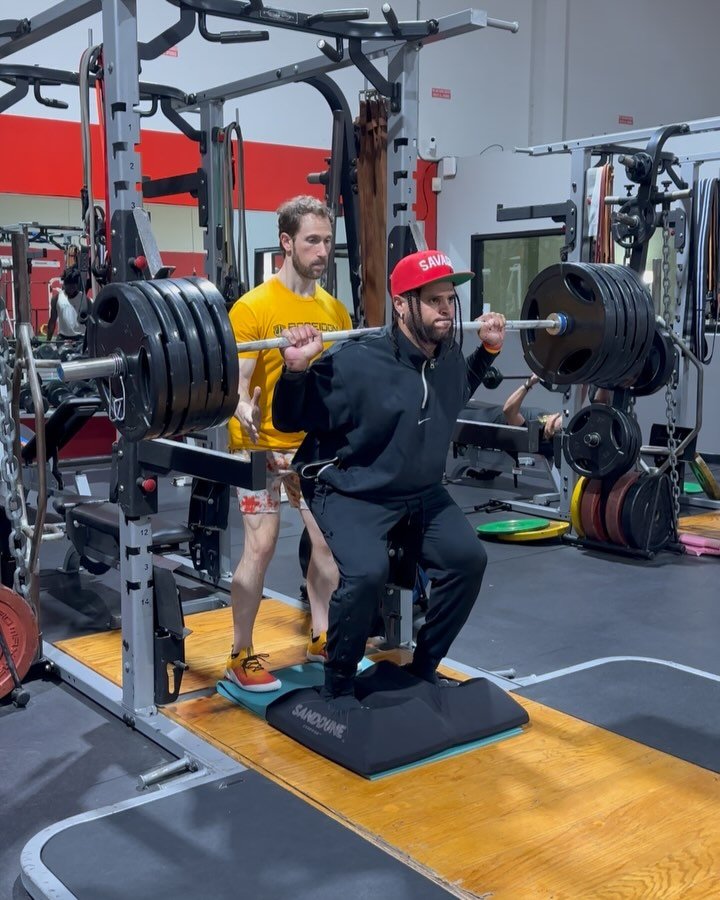
It’s also an excellent warm-up exercise to get the entire body functioning as a whole unit and sending blood flow to all major muscles of the body. During this specific workout I had Drew work these in with heavy eccentric isometric squats, eyes closed floor press, eyes closed inverted rows, reverse depth drops, and single arm planks.

| EXERCISE | SUPERSET | SETS | REPS | REST | RPE | EI |
|---|---|---|---|---|---|---|
| Single Arm Weighted Planks | #6,#7,#8 | 2 | 14" per side (switch every 7 ") | 60" | 7 | N/A |
Read About Exercise
If I could only choose one core exercise the single arm plank and variations thereof would be it as it’s one of the most simple yet effective core stabilization drills in existence. With that said here are 10 cues for single arm planks
Try to stay as tight as you can with every muscle braced from head to toe.
A wider stance is easier, while a narrower stance works the core stabilizers more intensely. Generally, use a stance that's slightly wider than shoulder width.
Place the non-working arm towards the side of the body without that arm actually touching the outer hip. Supporting the leg with the arm is a subtle form of cheating.
Focus on squeezing the non-working arm and keeping it tight to activate the lats and shoulder stabilizers of the opposite side via neuromuscular cross-transfer.
Keep both legs fully straight rather than allowing a slight knee bend. This helps you to keep a tall hip position and hollowed core instead of sagging at the hips.
Try to stay as tall on the toes as possible rather than allowing the heels to sag.
Don't squeeze the glutes! This will disengage the hip flexors. The hip flexors play a pivotal role in any plank as they keep the hips from dropping.
Avoid a crowded and compressed spinal position. And don't allow the shoulders to round or elevate. Maintain a neutral spine by focusing on lengthening out the body while keeping the chest out and hips tall.
To avoid rotation, keep your torso as square to the floor as possible.
Once you can complete 30 sec of a standard single-arm plank on each side without a break, progress the movement by placing weight on your back or elevating your feet. You can increase the difficulty further by performing eccentric isometric renegade rows I demonstrate on my website. Read more HERE.

| EXERCISE | SUPERSET | SETS | REPS | REST | RPE | EI |
|---|---|---|---|---|---|---|
| Goblet Good Morning with Eccentric Isometrics | #6,#7,#8 | 2 | 5 | 60" | 6 | 3" |
Read About Exercise
If you’re looking for a good morning variation that reduces stress to the low back and spine while still pummels the entire posterior chain look no further than the front loaded variations such as this goblet version. The front loading position targets the core, abs, and spinal stabilizers quite intensely. These are also surprisingly brutal on the upper back, shoulders, and arms as you’ll be working overtime to keep the weight held tightly against the chest. Here are 4 benefits of this oftentimes undervalued exercise.
Increases glute and hamstring strength. Good mornings are one of the most effective posterior chain exercises when performed correctly as the amount of activation and tension throughout the glutes and hamstrings is unusually high. In fact, most folks will feel a greater stretch in their posterior chain on the good morning exercise than any other hip hinge variation.
Improves posture via increased upper back and lat activation. Because the barbell is loaded above the center of mass and the torso is bent over as a result of hinging at the hips this creates a very biomechanically disadvantageous position. However it's also a position that really engages not only the entire posterior chain of the lower body but creates extreme activation of all the spinal and shoulder extensors. In fact the entire back from the lower back muscles all the way to the lats, rhomboids, rear delts, traps, and neck have to work overtime to keep the spine and shoulders in a neutral position while resisting flexion forces. With that said the good morning is one of the best posture exercises in existence.
Increases squat and deadlift strength. For decades many powerlifters have claimed that the good morning exercise has improved their squat and deadlift strength more than any other movement. This is also something I’ve noticed with my athletes as it not only increases posterior chain strength but also teaches the athlete how to stay tight and maintain spinal rigidity during heavy axial loaded movements.
Bulletproofs the low back. The good morning can be a double edged sword. When performed properly it builds phenomenal back strength, improves postural alignment, and teaches the individual how to engage their hips all of which can improve low back health tremendously. However, if it’s performed incorrectly it can also be quite injurious to the spine. The key is to start off light and perform the good morning with proper mechanics particularly while using eccentric isometrics as this helps the athlete dial in their form. Read more about eccentric isometrics in my book MOVEMENT REDEFINED.

| EXERCISE | SUPERSET | SETS | REPS | REST | RPE | EI |
|---|---|---|---|---|---|---|
| Single Arm Front Curled Goblet Squat | #9 & #10 | 2 | 3 per side | 45-60" | 7-8 | 3" |
Read About Exercise
The single arm goblet squat or single arm front curled squat is an excellent squat variation that really forces the lifter to engage their core and lock their hips into the proper position. The front curled position is similar to the goblet position.

| EXERCISE | SUPERSET | SETS | REPS | REST | RPE | EI |
|---|---|---|---|---|---|---|
| Weighted Knuckle Pushups | #9 & #10 | 2 | 5 | 60-90" | 8 | 3" |
Read About Exercise
Knuckle pushups are an excellent diagnostic tool for self-assessing your pushup mechanics. Because your placing significant stress across the knuckles, it’s critical all force vectors are perfectly vertical into the ground to avoid hand discomfort associated with wasted horizontal or lateral forces. This can only happen if mechanics, body positioning, and joint stacking are spot on. For example, if the lifter’s hands are either too far in or in back of the body or if the elbows tend to drift outward this places undue stress on 1 or 2 particular knuckles and finger joints making the movement feel highly uncomfortable and almost damaging.
However if all components of technique are perfectly dialed then equal stress is placed across all knuckles causing little of any discomfort. In fact with proper mechanics you should be able to perform these weighted on fairly hard surfaces with little if any discomfort as there is equal and balanced tension distributed throughout the entire hand and surface area. As an added bonus this can be invaluable for teaching proper punching mechanics as it reinforces the idea of landing a perfectly directed punch with the force-impact spread equally across all knuckles.

| EXERCISE | DURATION | # OF DRILLS | REST BETWEEN DRILLS | RPE |
|---|---|---|---|---|
| Low Intensity Interval Cardio | 30 minutes | 8 | 10-20 seconds | 4-6 |
LOW INTENSITY INTERVAL CARDIO
+ CLICK TO ENLARGE
Read About Cardio Workout
Today’s workout will focus on using various cardio machines while also attempting to optimize posture, body mechanics, foot and ankle alignment, and overall form. There will be 4 cardio stations and each will be performed for 5-7 minutes. Before each station the athlete will perform 4 activation drills to help ensure optimal mechanics and form during the cardio phases.
The activation sequence will involve the following 4 exercises. 1) Standing band row or seated cable row with eyes closed for 6-8 slow eccentric isometric reps, 2) Single leg stand with arms overhead and tall posture for 20 seconds per leg, 3) single leg plank for 10 seconds per leg, and 4) eccentric isometric lunges on each leg for 3 reps per side. Again, these will be performed 4 total times throughout the workout (one round before each of the following 4 cardio stations).
Cardio Station #1 will involve the upright bike with tall posture and proper shoulder mechanics throughout (shoulders down and back).
Cardio Station #2 will involve an incline treadmill walk at incline of 5.0-7.5 and speed of 3.8-4.5.
Cardio station #3 will involve the seated rowing machine at moderate to moderately intense pace throughout will maintaining tall posture throughout and tight core.
Cardio station #4 will involve any elliptical of your choice focusing on tall posture, head alignment, and relaxed traps/shoulders.