

Intense Workout
- Lower Body Emphasis -


WORKOUT SUMMARY (+ CLICK TO ENLARGE)
SEE BELOW FOR YOUR DETAILED WORKOUT WALKTHROUGH


| EXERCISE | SUPERSET | SETS | REPS | REST | RPE | EI |
|---|---|---|---|---|---|---|
| Single Leg Swaps on Soft Cushion or Mat | #1,#2,#3 | 3 | 30" per leg | 60" | 7-9 | N/A |
Read About Exercise
Here I have 6’9” NFL athlete Demar Dotson (Tampa Bay Buccaneers) performing the single leg swap, an exercise I introduced to the fitness community nearly 5 years ago on T-Nation. With that said, improving foot & ankle function is something I work on quite extensively with my athletes. That’s because areas of dysfunction, particularly in the lower body, are all related, as each affects the others. For example, if the feet & ankles are not functioning as they should, this impacts activation patterns throughout the muscles around the hips, knees, & spine.
The upside to this neuromuscular chain reaction is that improvement in one area tends to have a positive impact on all others. For example, train the feet & ankles to fire properly, and the majority of issues in the knees, hips, low back & core tend to improve greatly This is where the Single-Leg Kettlebell Swap (AKA single leg kettlebell switch or kettlebell handoff) comes in. I've found it to be highly effective at improving lower-body function, alignment & muscle activation from the feet to the hips. In fact, this was an exercise I developed out of pure necessity after witnessing a large number of athletes who displayed various types of foot & ankle deficiencies that were wreaking havoc on the rest of their bodies, particularly in the knees, hips & low back.
If you want to master your foot and ankle mechanics check out my Ultimate Foot & Ankle Manual HERE (a must-have resource for any athlete, lifter, physical therapist, personal trainer, or strength coach). Also, read more about single leg swaps including 10 variations that involve single leg squats, rdl’s, lunges, Bulgarian squats, & more in full article HERE.

| EXERCISE | SUPERSET | SETS | REPS | REST | RPE | EI |
|---|---|---|---|---|---|---|
| Trap Bar or Dumbbell Deadlifts on Unstable Surface | #1,#2,#3 | 4 | 5,4,3,2 | 8-9 | 75-90" | 2" |
Main Option
Alternate Option
Read About Exercise
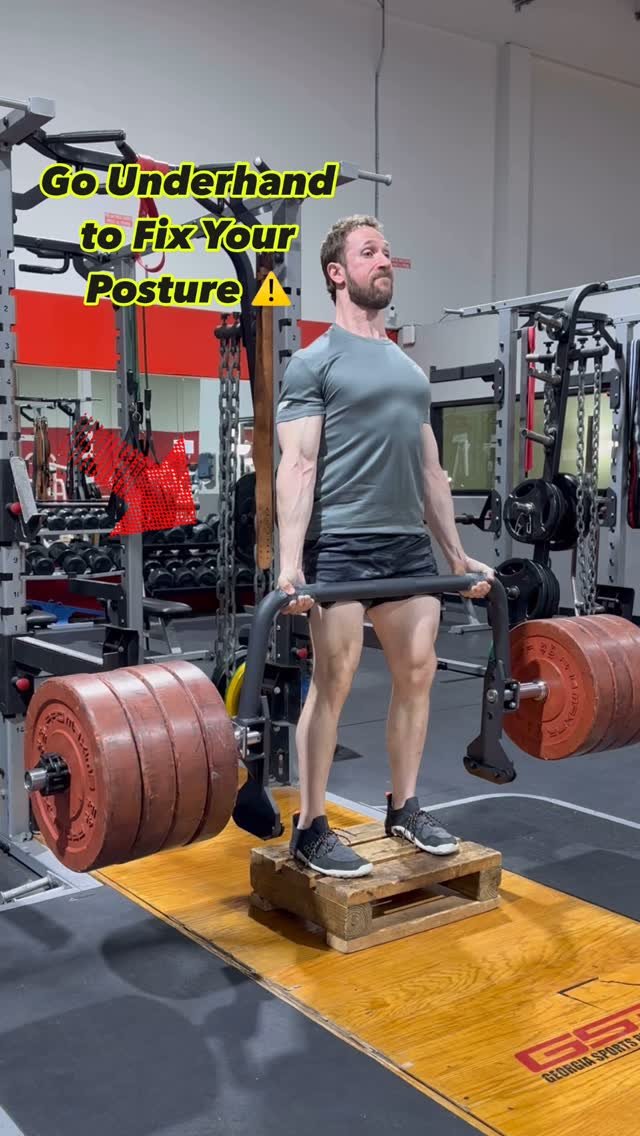
Main Option (Trap Bar or Dumbbells)
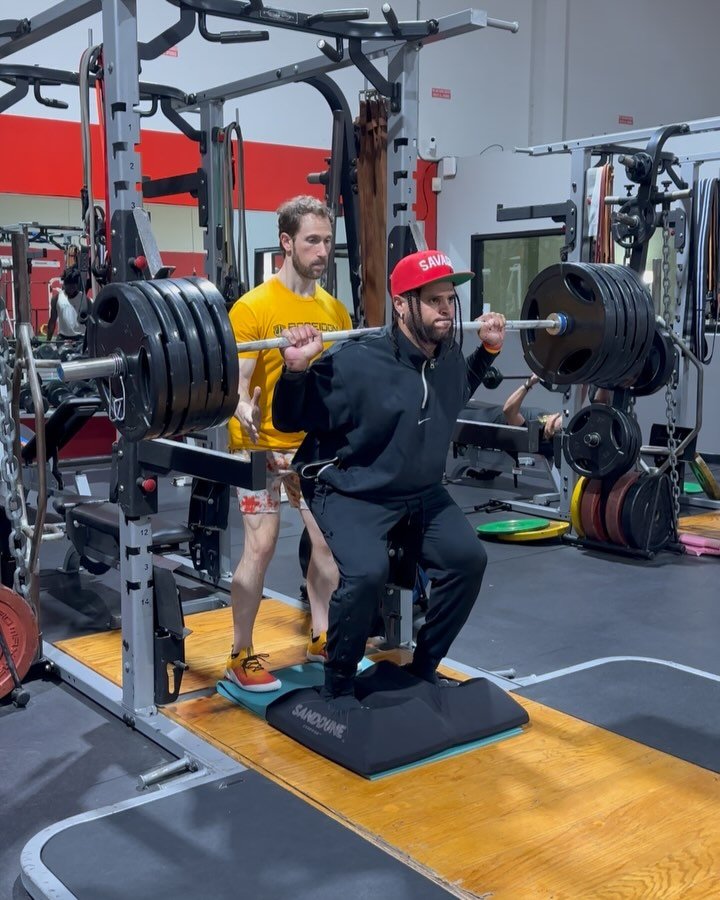
This next exercise is an eccentric isometric trap bar or dumbbell deadlifts. I recommend using an unstable surface such as a mat. In the video I'm using with my clients a Sanddune. The Sanddune stepper is a relatively simple yet incredibly effective training device that essentially mimics sand & soft memory foam. Again, something similar can be recreated with a soft stretching mat.
Besides working the larger muscles of the body, the smaller muscles especially in the foot & ankle complex as well as the core get crushed. If you have poor foot, toe, & ankle activation and are looking for a functional training tool that helps assist proper recruitment in these distal extremities look no further than the Sanddune. Besides the enhanced proprioceptive feedback and foot & ankle activation, the Sanddune is also very versatile & can be used for any standing exercise for lower & upper body as well as explosive drills. Even if you’re not into unstable surface training, the Sanddune provides just the right balance of cushion & instability without being so unstable that it limits loading & proper execution. If you like the Sanddune in the video you can get 10% off using code drjoel.
Alternate Option
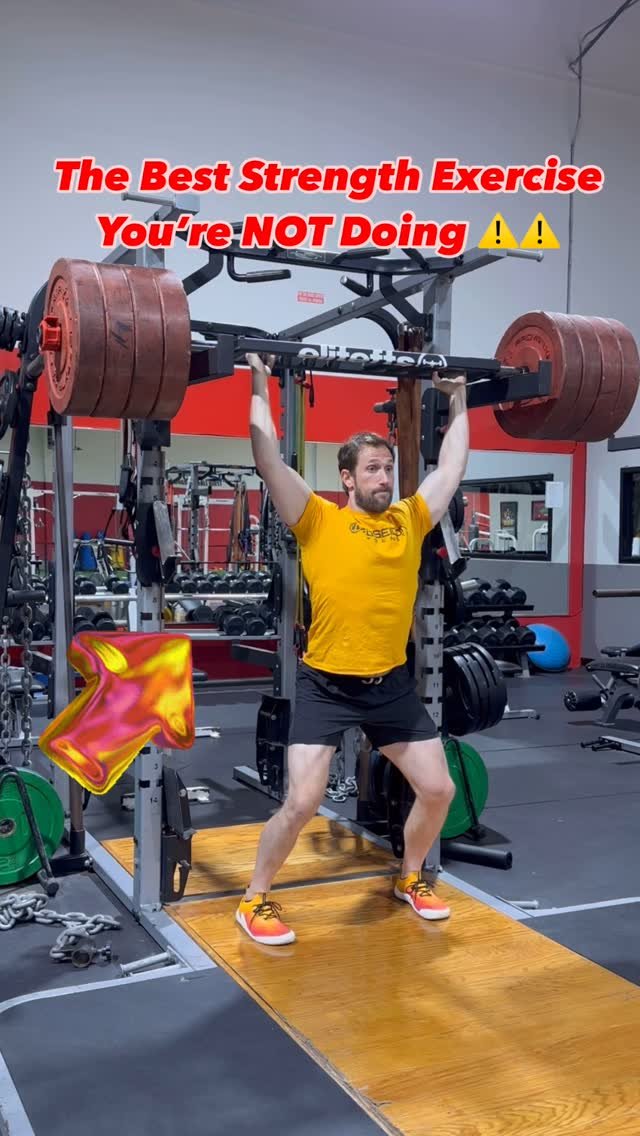
Front squats are an incredible exercise for taxing the legs particularly the upper thighs and quads. However, because of the unique loading method that involves placing the bar on the anterior portion of the body instead of the upper back (i.e. back squat), they also provide a strong stimulus to the core and upper back. Employing accommodating resistance in the form of bands on chains on front squats may help maximize the various benefits to an even greater extent while helping to eliminate a some common problems. Here's 5 reasons why. Read the full length article HERE.

| EXERCISE | SUPERSET | SETS | REPS | REST | RPE | EI |
|---|---|---|---|---|---|---|
| Power Snatches from Pins/Blocks (Band Resistance Optional) | #1,#2,#3 | 4 | 3-4 | 60-90" | 7-9 | 2" |
Main Option
Alternate | Easier Option
Read About Exercise
Main Option
Here I’m performing power snatches from pins (similar to blocks) with a modified version of accommodating resistance. You can use standard accommodating resistance or the modified version I show here where the band tension doesn’t kick in until just after the 2nd pull. I prefer this method for several reasons.
The band resisted Olympic lifts on cleans and snatches is something I actually picked up from Westside Barbell founder Louie Simmons. So if you have issues with this protocol take it up with Louie and his boys at Westside Barbell as I’m sure they would love to hear from you. Note: I use olympic lifts for athletic performance not for competitive weightlifting.
With that said there are 4 reasons for using band resistance on Olympic lifts.
Requires more explosive hip power. Because the weight gets heavier the higher the weight is pulled (once you reach mid torso), this requires the lifter to produce more violent triple extension (in the hips, knees, & ankles) in order to overcome the higher positions & blast through the overloaded phase of the lift. In fact one of the most common problems on Olympic lifts is that individuals rely on incomplete yet quick hip extension by producing a mini hop or jump to jolt the weight up into the catch position. Instead of jumping using a partial hop, the lifter should be trying to drive into the floor for as long yet as aggressively as possible in order to maximize hip extension forces. Although many strength coaches erroneously advocate faulty mini-jump mechanics (using incomplete hip extension), which emphasizes knee & ankle extension rather than hip extension, the band resistance technique helps to eliminate this for two reasons: First the weight is so heavy at the top the athlete is forced to finish with the hips as the weight will stall out on the second pull of the lift (once the bar reaches mid torso height). Simply put you’ll be forced to accelerate the load with the hips. Second, because the catch phase of the lift involves unusually heavy loads and tension (due to the bands), jumping and catching with such high tension feels incredibly jarring and unnatural to the body not to mention that it’s both dangerous and ineffective. Simply put if you have an athlete that needs to eliminate the common faulty jump clean (rather than full hip extension) band resisted hang clean technique will immediately help resolve this as it punishes this common error yet rewards proper hip extension patterns. This is something I’ve been working on with Drew as he was erroneously taught in high school to jump when performing Olympic lifts. The combination of using band resistance, band assistance, and eccentric isometric variations of Olympic lifts has done wonders for eliminating this issue and teaching him to get violent triple extension particularly in the hips.
Teaches the lifter a better catch and rack position. If you have an athlete who’s having difficulty with the catch position of their clean or snatch and does not receive the barbell quickly enough, band-resisted variations immediately remedy this. For instance on the clean, anything but quick, violent, and aggressive racking where the athlete forcefully snaps their elbows forward when catching the barbell will literally cause the barbell to launch right back down to the starting position. In addition, the athlete will be required to keep their elbows high throughout the duration of the racked position for the same exact reasons. Besides improving their clean technique this also does wonders for improving upper back strength and posture as the surrounding musculature must work overtime when catching a band resisted clean.
Teaches better force absorption. Olympic lifts provide just as much benefit for teaching force absorption as they do for reinforcing force production and explosive hip power. That’s because the lifter must learn to receive heavy loads by strategically positioning and activating their body, essentially bracing their entire neuromuscular system to catch the heavy barbell. Incorporating band resistance further magnifies the benefits associated with force absorption and deceleration both of which are critical for performance and function. As an added bonus the core strength produced from teaching your body to stabilize the spine when catching these unusually heavy loads (typically supramaximal tension due to the bands) in the front racked position is unparalleled.
Teaches proper bar path. A common mistake when performing cleans and snatches is to drive the weight straight up rather than up and slightly back towards the body. This helps to ensure the bar stays close to the body and does not get too far away from the lifter. With the band resistance if the bar gets even a few centimeters too far in front of the body and the lifter does not keep the bar close throughout the entire movement, the bands will literally rip the bar right back down to the starting position. Simply put the lifter is forced to pull the bar up and slightly back towards their upper torso which represents ideal mechanics. You’ll also notice I use a quick stretch reflex or pre-stretch to initiate the movement. Deadstop training from blocks or pins can be performed with or without the stretch reflex. However, most athletes will find they achieve greater power as well as sensory feedback from muscles spindles by quickly pre-stretching or preloading their posterior chain and producing a stretch reflex immediately before initiating the concentric or pulling phase. It’s a subtle quick stretch (almost looks like a small hitch prior to the lift off) but internally and intramuscularly it feels quite different than traditional deadstop training where the athletes typically would have very little muscle spindle recruitment and pre-loading prior to the concentric.
Alternate | Easier Option
The narrow stance dumbbell squat jump is a great way to simulate a typical jump position in terms of foot placement while providing a high amount of external loading. Besides being an excellent speed and power movement for the lower body, the traps and upper back get absolutely crushed from this due to the rapid eccentric contraction produced from having to catch and delegate the dumbbells during the landing phase. Ideally the goal is to work up to handling at least half of your bodyweight when combining the weight of both dumbbells. However start with very light loads to work on mechanics and technique before increasing the weight.

| EXERCISE | SUPERSET | SETS | REPS | REST | RPE | EI |
|---|---|---|---|---|---|---|
| Barbell Good Mornings | #4 & #5 | 3 | 4 | 60-90" | 7-9 | 2" |
Read About Exercise
The good morning is not just a “good” exercise, it’s a great exercise provided it’s performed correctly. Unfortunately it often gets a bad rap as many folks have injured themselves on this old-school bodybuilding classic exercise. Essentially it comes down to proper execution and optimal body mechanics just as it does for any other movement. In fact with proper form the good morning is one of the most therapeutic posterior chain movements in existence. However, with improper mechanics it’s also one of the most dangerous. The difference lies in the execution.
The good morning exercise is nothing more than a traditional hip hinge movement except the weight is loaded above the center of mass typically on the upper traps and back like a barbell squat. Rather than squatting down by bending the knees and hips at the same rate, the lifter will simply hinge over at the hips while maintaining a soft knee position throughout. When it doubt it’s better to have a bit more knee bend than not enough.
Focus on finding the natural stopping position which will be at approximately 90 degrees (slightly above parallel). In reality, the movement pattern is identical to an RDL (Romanian deadlift) or any other hip hinge movement for that matter.
BENEFITS
Let's discuss 4 benefits of this oftentimes undervalued exercise.
Increases glute and hamstring strength. Good mornings are one of the most effective posterior chain exercises when performed correctly as the amount of activation and tension throughout the glutes and hamstrings is unusually high. In fact, most folks will feel a greater stretch in their posterior chain on the good morning exercise than any other hip hinge variation.
Improves posture via increased upper back and lat activation. Because the barbell is loaded above the center of mass and the torso is bent over as a result of hinging at the hips this creates a very biomechanically disadvantageous position. However it's also a position that really engages not only the entire posterior chain of the lower body but creates extreme activation of all the spinal and shoulder extensors. In fact the entire back from the lower back muscles all the way to the lats, rhomboids, rear delts, traps, and neck have to work overtime to keep the spine and shoulders in a neutral position while resisting flexion forces. With that said the good morning is one of the best posture exercises in existence.
Increases squat and deadlift strength. For decades many powerlifters have claimed that the good morning exercise has improved their squat and deadlift strength more than any other movement. This is also something I’ve noticed with my athletes as it not only increases posterior chain strength but also teaches the athlete how to stay tight and maintain spinal rigidity during heavy axial loaded movements.
Bulletproofs the low back. The good morning can be a double edged sword. When performed properly it builds phenomenal back strength, improves postural alignment, and teaches the individual how to engage their hips all of which can improve low back health tremendously. However, if it’s performed incorrectly it can also be quite injurious to the spine. The key is to start off light and perform the good morning with proper mechanics particularly while using eccentric isometrics as this helps the athlete dial in their form. Read more about eccentric isometrics in my book MOVEMENT REDEFINED.
As long as you're technique is locked in, going heavy on good mornings as I'm showing here with 315 pounds isn't an issue. In fact you're at a greater risk for injuring your back with light weight and poor form than you are with heavy weight and strict technique. It's all about the mechanics. Read more about proper good morning technique and hip hinge mechanics HERE.

| EXERCISE | SUPERSET | SETS | REPS | REST | RPE | EI |
|---|---|---|---|---|---|---|
| Trap Bar Bulgarian Squats | #4 & #5 | 3 | 4-5 | 60-90" | 8-9 | 2-3" |
Read About Exercise
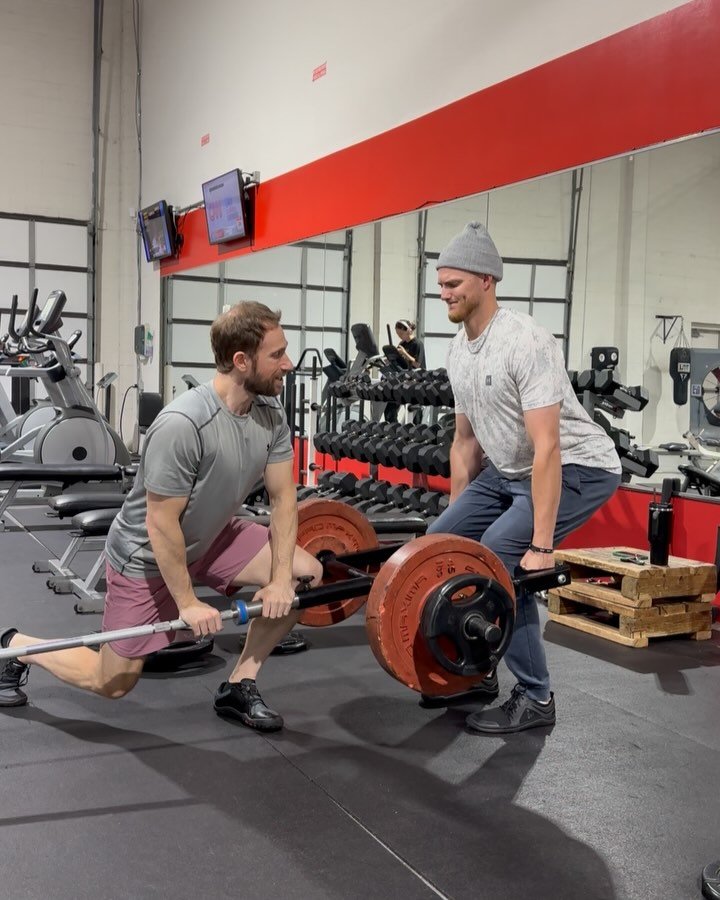
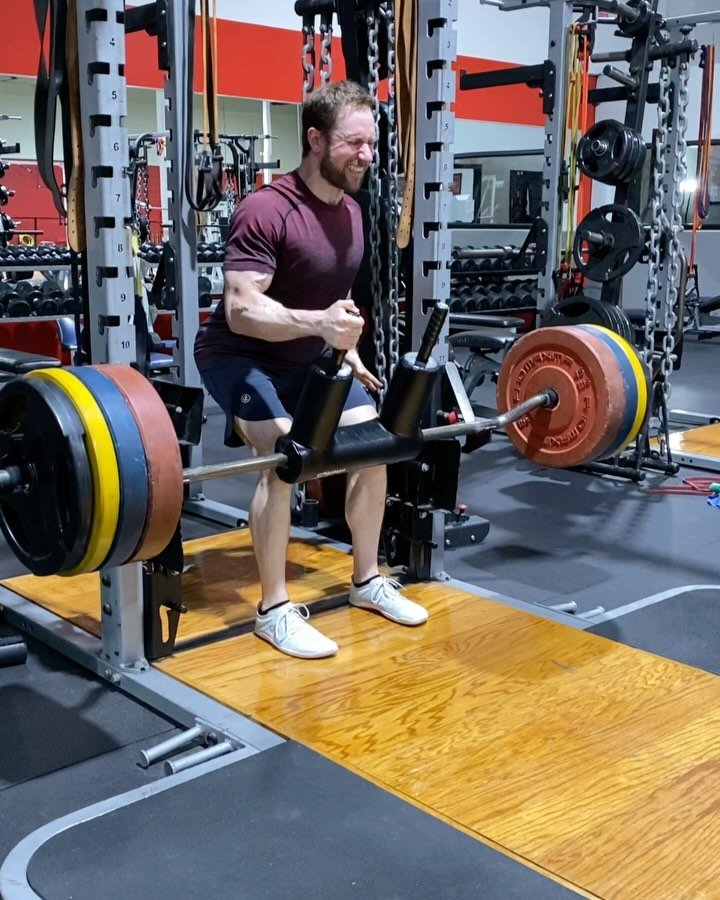
The trap bar is one of my favorite training tools as it provides a variety of unique exercises and loading parameters. Here’s one of my awesome clients Leslie Petch showing how it’s done with eccentric isometric Bulgarian squats. On a side note, huge congrats to Leslie for taking multiple 1st place prizes in the NPC South Carolina Championships this weekend.
Although the trap bar can be can be used for squats, deadlifts, chest presses, overhead presses, bent over rows, pullups, squat jumps, and even lunges, Bulgarian squats are one of the most brutal variations you can perform however the stimulus to the entire lower body is incredible. Also shout-out to Kelvin King Jr. for inspiration for some of these unique single leg trap bar exercises. If you’re not following this guy you should as his work is top notch.
There are 4 unique benefits of the trap bar Bulgarian squat.
- This specific Bulgarian squat variation is one of the single best training tools for reinforcing proper hip hinge mechanics on split squat and lunge variations. Essentially any type of lunge, Bulgarian squat, or split squat should involve ample forward lean with a solid hip hinge throughout. This is something I’ve addressed in previous articles, as it’s imperative not only for taxing the surrounding musculature but also for taking stress off the joints. An upright lunge or upright Bulgarian squat is wrong plain and simple.
When using the trap bar if the torso becomes too upright and the lifter fails to implement the hip hinge mechanics, this drives the rear thigh forward and it runs into the back portion of the trap bar making it impossible to perform the exercise. In fact the only way you can successfully perform these is by using a proper hinge throughout the movement with a forward lean This is true of the lunge or Bulgarian squat variation as the movement mechanics are nearly identical. Read more HERE.

| EXERCISE | SUPERSET | SETS | REPS | REST | RPE | EI |
|---|---|---|---|---|---|---|
| Back Extension Dumbbell Rows | #6 & #7 | 2-3 | 5 | 60" | 3-5 | 2" |
Read About Exercise
The back extension row is an awesome movement for crushing the entire posterior chain from head to toe and working all of the postural muscles. It's also an incredible exercise for increasing strength and size in the entire upper back and lats. Although most individuals use this is a lighter accessary movement, as long as you use proper form you can actually load this movement with heavy weight and create substantial overload.

| EXERCISE | SUPERSET | SETS | REPS | REST | RPE | EI |
|---|---|---|---|---|---|---|
| Single Arm Single Leg Bottoms Up Chest Press | #6 & #7 | 2-3 | 4 per side | 60" | 5-6 | 2-3" |
Read About Exercise
Looking to take your chest & core training to the next level? Try this brutal exercise demonstrated by pro baseball player Parker Meadows as we had him combine several of my favorite methods including, bottoms up, single leg, t-bench, head off chest press, using an eccentric isometric protocol. If your core & hips aren’t firing with near maximal effort you’ll literally feel like you’re going to flip off the bench or dump the kettlebell.
This is literally a full body pressing movement as you’re forced to activate every muscle in your body from head to toe as you resist enormous amounts of rotational forces. In addition this is one of the more physically exhausting chest presses you’ll ever attempt due to the high levels of continuous intramuscular tension. Besides devastating your glutes, it’s also one of the most brutal core exercises you’ll ever perform as it absolutely crushes your obliques & transverse abs as well as your rectus abs.
Additionally the eccentric isometric helps the lifter fine-tune their body mechanics due to the enhanced proprioceptive feedback & kinesthetic awareness associated with slow & controlled eccentrics. When combined with the unstable elements of the exercise above, this does wonders for cleaning up body mechanics, muscle dysfunction, & imbalances.
Lastly, if you have poor foot & ankle activation you’ll be notified almost immediately as you’ll find it quite difficult to maintain your balance on these. In fact the only way you can reach equilibrium with your body on this movement and find a stable position is by producing perfect foot & ankle alignment.

| EXERCISE | SUPERSET | SETS | REPS | REST | RPE | EI |
|---|---|---|---|---|---|---|
| L-Sit Lat Pulldown | #8,#9,#10 | 2 | 4-5 | 60" | 4-5 | 3-4" |
Read About Exercise
The L-Sit Lat pulldown is another great vertical pulling or pulldown motion that not only targets the lats and upper back but helps to minimize excessive lumbar extension which is all too-common in many lifters. For a detailed overview on proper technique see the second video tutorial.

| EXERCISE | SUPERSET | SETS | REPS | REST | RPE | EI |
|---|---|---|---|---|---|---|
| Legs Up Z Press On Bench | #8,#9,#10 | 2 | 5 | 60-90" | 7 | 2-3" |
Read About Exercise
When it comes to building a strong, functional, and jacked upper body, mastering the overhead press is a must. Unfortunately dialing the overhead press is easier said than done as it can be quite tricky for many lifters. While there are a number of techniques and training methods I use to enhance the overhead press (particularly eccentric isometrics applied to a number of overhead pressing variations), one of my favorite variations is the Z Press.
Perhaps the most challenging variation of any Z press you’ll ever attempt, the leg raise z press off a bench, requires even greater levels of stability, core strength, motor control, mobility, and proper overhead mechanics in comparison to other overhead presses. The eccentric isometric protocol further adds to the difficulty and the effectiveness.
To perform, simply sit towards the end of a bench with your upper middle hamstrings approximately at the edge of the bench and perform an overhead press while keeping the legs perfectly straight and your ankles dorsiflexed. This is without a doubt one of the trickier overhead pressing variations not only because of the mobility required to complete these but also because of the inordinately high levels of instability involved.
Traditional Z press is already quite challenging to stabilize and control, however these take the intensity several notches further as the lifter has minimal support and must use their core and just about every muscle from head to toe to dial these in. In addition, any degree of excessive momentum, shifting, wiggling, or faulty positioning will cause the lifter to lose their balance. In fact, I highly recommend performing these using a controlled eccentric isometric protocol as I demonstrate in the video. This not only places greater tension on the targeted musculature but also helps the lifter optimize their mechanics and fine-tune their body positioning due to the enhanced proprioceptive feedback associated with eccentric isometrics. Read more HERE.

| EXERCISE | SUPERSET | SETS | REPS | REST | RPE | EI |
|---|---|---|---|---|---|---|
| Heel and Toe Raises with Dumbbells | #8,#9,#10 | 2 | 10 | 60" | 8 | N/A |
Read About Exercise
Performing combination heel and toe raise sets is a great way to hit both portions of the lower leg and improve muscle function throughout the foot and ankle complex. It's also an excellent drill for helping with shin splints and vertical jump performance. Performed with the pinching dumbbell technique as shown here by one of my athletes also helps to build strength in the hands, grip, fingers, and forearms.

| EXERCISE | DURATION | # OF DRILLS | REST BETWEEN DRILLS | RPE |
|---|---|---|---|---|
| High Intensity Intervals (HIT) Cardio | 30 minutes | 9 | 10-20 seconds | 7-9 |
HIGH INTENSITY INTERVAL CARDIO (HIT)
+ CLICK TO ENLARGE