

Speed & Power Workout
- Full Body Emphasis -


WORKOUT SUMMARY (+ CLICK TO ENLARGE)
SEE BELOW FOR YOUR DETAILED WORKOUT WALKTHROUGH


| EXERCISE | SUPERSET | SETS | REPS | REST | RPE | EI |
|---|---|---|---|---|---|---|
| Longitudinal Goblet Squat Jump | #1,#2,#3 | 3 | 3 | 30-60" | 4-5 | 2-3" |
Read About Exercise
This exercise is an eccentric isometric jump squat using the longitudinal goblet squat protocol. The squat is perhaps the most basic yet foundational human movement pattern. Unfortunately most folks have difficulty mastering their form oftentimes leading to variety of form aberrations, joint issues, and neuromuscular hiccups.
Eccentric isometrics not only help maximize squat form but they also produce phenomenal gains in lower body strength, functional hypertrophy, stability, mobility, symmetry, and motor control. When combined with the jump this makes for one incredibly potent duo for enhancing speed, power, and athletic performance as well as force absorption and deceleration. The longitudinal goblet squat position further enhances this stimulus as discussed in one of my posts from earlier this year. This eccentric isometric protocol is a topic I expound on in great depth in my book MOVEMENT REDEFINED.

| EXERCISE | SUPERSET | SETS | REPS | REST | RPE | EI |
|---|---|---|---|---|---|---|
| Dumbbell Snatch with Eccentric Isometric RDL's | #1,#2,#3 | 3 | 3-5 | 60" | 5-6 | 1-2" |
Read About Exercise
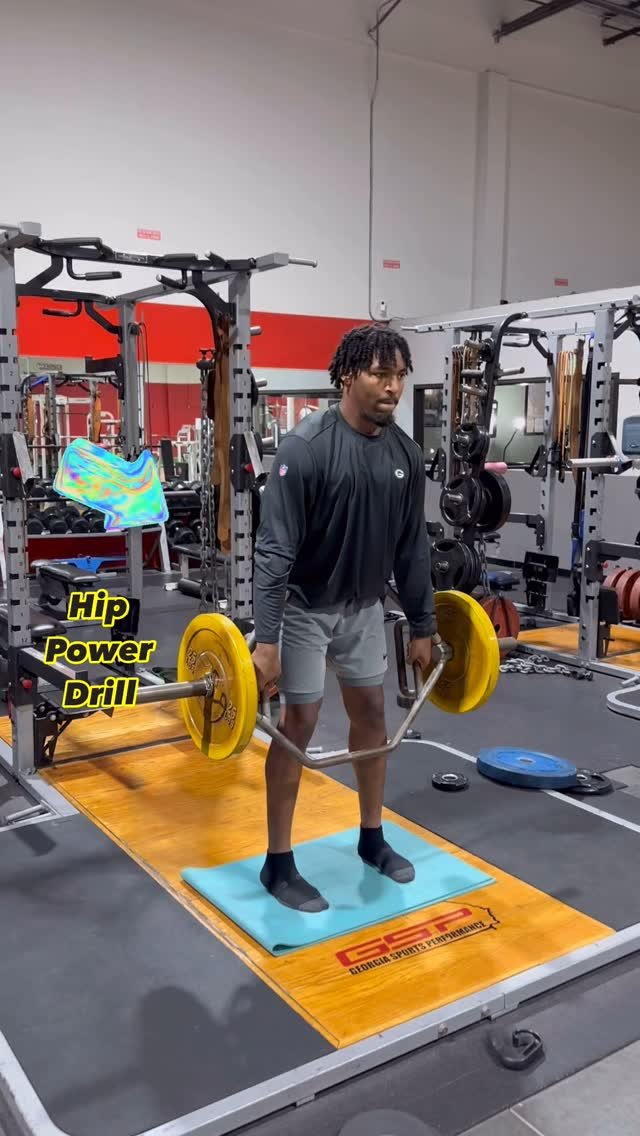
Using Olympic lifts for athletic performance is very different than using them for competitive weightlifting. For example, here’s an eccentric isometric RDL dumbbell snatch as shown by NFL athletes Brandon Chubb. Is this something I would recommend for competitive Olympic weightlifters? Probably not. Would I recommend it for other athletes? Yes!!
The sport of Olympic weightlifting and the lifts involved (clean & jerk, and snatch) are some of the most physically, mentally, & technically challenging skills one can learn. Unfortunately many of the techniques needed to excel in the sport of Olympic weightlifter require the lifter to sacrifice optimal human biomechanics in order to maximize the physics required to “successfully complete” their lifts. For instance many positions involved in weightlifting often involve an excessively arched back rather than a neutral spine in order to create the strongest vertical force vector.
Additionally it’s often thought that maintaining cervical hyperextension (looking up) helps place the weightlifter into the most ideal position for maximizing the physics of the lift by keeping them more upright. Excessive toe flare, extreme external rotation of the hips, exaggerated knee spread, excessive anterior knee drift, extreme ATG squat depth, and even the relatively delayed timing of the second pull are all elements that many Olympic weightlifting coaches advocate. While these components are quite useful for helping an individual excel at the sport of Olympic weightlifter it could also be argued that each of these contribute to a variety of dysfunctional patterns.
For instance many weightlifters have aberrant running & sprinting mechanics. They may be able to jump high & produce good power from a stand still position on a single rep, but watch any Olympic lifter run or perform any movement that requires quick, repeatable cyclical movements in a rhythmic & coordinated fashion, and you’ll notice some pretty significant aberrations in their mechanics. Many of their strides resemble those of a cowboy from the Wild West who just completed a marathon horse-back ride.

| EXERCISE | SUPERSET | SETS | REPS | REST | RPE | EI |
|---|---|---|---|---|---|---|
| Deconstructed Single Leg Overhead Medicine Ball Slam | #1,#2,#3 | 3 | 5-6 per side | 45-60" | 5-6 | 2" |
Read About Exercise
The overhead medicine ball slam is a simple yet very effective explosive power movement. Once athletes become efficient with it I like to progress them to more advanced variations that challenge additional biomotor capabilities. Here’s an example of that as I have Pittsburgh Pirates baseball player Austin Meadows performing a deconstructed Single leg Medicine Ball Slam. And yes you’ll need to master your single leg hip hinge before attempting these. Although Austin is making this look quite easy, this is one of the most challenging medicine ball variations you’ll ever attempt as it requires several key components.
First and as the name implies you’ll be deconstructing or breaking down the movement into individual segments all while holding your balance on one leg. This component in and of itself is quite challenging. As you drive the ball overhead the opposite leg will move into hip flexion while also maintain dorsiflexion in that foot and ankle. The concentric explosive phase requires high power output yet also significant control and stability. In other words it’s teaches athletes to control and harness their power - a very critical yet oftentimes undervalued aspect of athletic performance.
As you explode into the floor and reach the bottom position you’ll be required to brace your entire body and fire your core in order to stabilize your position while catching the ball. In addition, this bottom position should terminate in a perfect single leg hip hinge/RDL position. This is actually the most challenging portion for most athletes as a majority of folks erroneously perform single leg RDL’s without maintaining a 90-degree angle in their back leg. To read more about proper single leg hip hinge mechanics check out my full length in depth article at https://www.advancedhumanperformance.com/blog/master-the-single-leg-rdl-hip-hinge

| EXERCISE | SUPERSET | SETS | REPS | REST | RPE | EI |
|---|---|---|---|---|---|---|
| Eyes Closed Rotational Bird Dog Row | #4 & #5 | 3 | 4 per side | 60" | 5 | 2-3" |
Read About Exercise
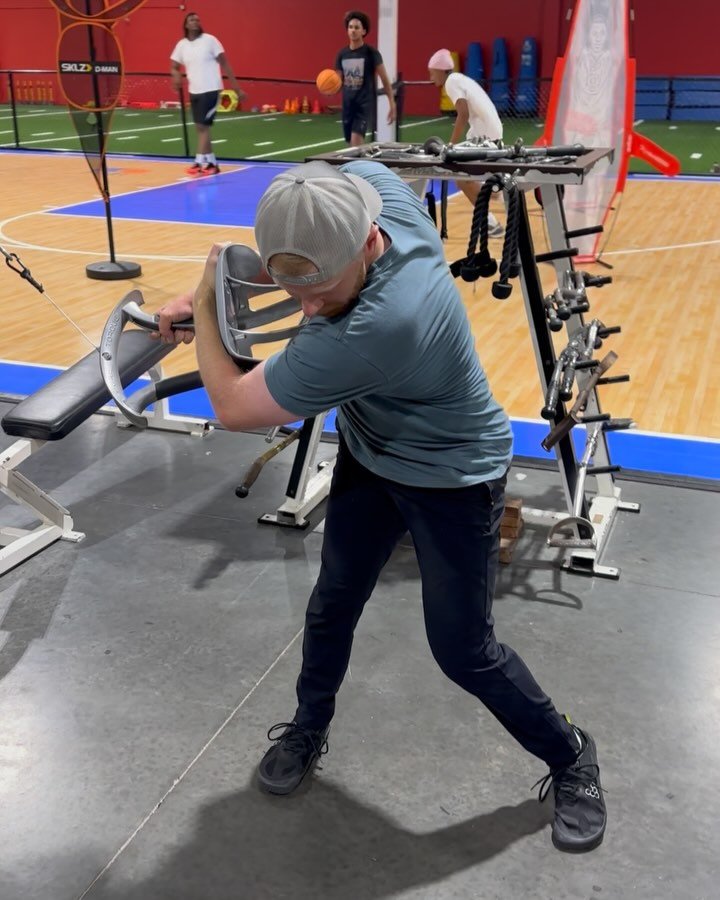
Here’s one of my NFL athletes Brandon Chubb demonstrating a very difficult narrow base bird dog quadruped row with a 75 lb dumbbell. Notice how he’s also using the rotational dumbbell version which requires incredible core strength as well as back and lat activation. With that said there are 5 key benefits to this.
The narrow base (widthwise on the bench rather than lengthwise) is significantly more challenging as it requires even greater body control & stricter mechanics to remain stable.
One of the beneficial features about the narrow base bird dog rotational row is that it allows for heavy loads to be used without hitting the bench. In contrast during the standard quadruped bird dog row (kneeling lengthwise on a bench) the bench gets in the way especially when rowing a thicker/heavier dumbbell or kettlebell. These remedy this common issue.
The rotational row is very conducive for reinforcing natural scapulohumeral rhythm and centrated glenohumeral joint mechanics (locked in shoulder joint).
The rotational movement is also very effective for stimulating significant lat activation & growth. That’s because the overhand/pronated position allows a greater lat stretch during the eccentric phase, while the underhand or supinated position produces a more forceful contraction in the lats at the end of the concentric rowing phase. This produces mechanical tension, muscle damage (to a moderate degree), metabolic stress, & local occlusion. As a result the stimulation to the lats & upper back is enormous
The rotational method combined with the unstable bird dog position absolutely blasts the core & abs as it increases rotational forces acting on the spine that the lifter must resist. See my top 12 favorite bird dog rows as well as numerous cues and coaching tips HERE.

| EXERCISE | SUPERSET | SETS | REPS | REST | RPE | EI |
|---|---|---|---|---|---|---|
| Rapid Eccentric Isometrics Flat Dumbbell Press | #4 & #5 | 3 | 4 | 45-60" | 4-5 | 3" |
Read About Exercise
Keep the hands neutral throughout. This keeps the scapula and shoulder joint in the proper position allowing the strongest and safest biomechanics. Proper horizontal pressing mechanics are a key factor when it comes to maximizing performance and muscle function. Performing chest presses with eccentric isometrics are very effective for creating this response as the protocol allows the lifter to tune into their body's proprioceptive feedback and make the necessary adjustments for optimizing body mechanics. Dumbbell variations tend to be easier and more natural for performing eccentric isometrics although other tools such as barbells, kettles, and specialty barbells can also be used.

| EXERCISE | SUPERSET | SETS | REPS | REST | RPE | EI |
|---|---|---|---|---|---|---|
| Rapid Eccentric Isometric Pullups | #6 & #7 | 3 | 3 | 45-60" | 4-5 | 2-3" |
Read About Exercise
The rapid eccentric isometric pull-up/chin-up variation is a highly advanced yet very effective back exercise that teaches the muscles of the lats, arms, and core, to activate rapidly as a means of absorbing force and quickly decelerating the body. The key is to avoid collapsing at the bottom position by allowing the shoulder to excessively elevate or protract.
Rapid Eccentric Isometrics are an advanced proprietary training technique developed by Dr. Joel Seedman used to increase proprioceptive feedback from muscle spindles with the goal of improving performance and muscle function. Rapid Eccentric Isometrics (REI’s) also improve rate of force development (RFD), Rate of Stabilization Development (RSD), Rate of Force Absorption (RFA), and Reactive Stabilization as the muscles are forced to turn on rapidly to absorb high impact forces. Rapid Eccentric Isometrics should only be used once proper form has been established with standard eccentric isometrics (EI’s).

| EXERCISE | SUPERSET | SETS | REPS | REST | RPE | EI |
|---|---|---|---|---|---|---|
| Eyes Closed Reverse Bottoms Up Press | #6 & #7 | 3 | 3 | 45-60" | 4-5 | 2-3" |
Read About Exercise
You’ve probably heard it a hundred times; if you’re an overhead athlete you shouldn’t perform overhead presses right? Wrong!!! In fact overhead presses and variations thereof are something I routinely use with all of my overhead athletes. Case in point, here’s Pittsburg Pirates outfielder Austin Meadows performing a reverse bottoms up overhead press with kettlebells. I started working with Austin several months ago at which time he had several injuries including a very complex shoulder issue that was preventing him from throwing. By strategically implementing numerous eccentric isometrics into his routine (for both upper and lower body) alike including the implementation of many overhead pressing variations, Austin is now back to throwing bombs and crushing his batting sessions.
In addition, I had Austin perform no additional corrective exercises, rotator cuff drills, soft tissue work, stretches, mobility drills, or any other treatment for his shoulders. Instead we relied on the correct execution of foundational movement patterns combined with properly performed eccentric isometrics to provide all of the therapeutic effects that Austin needed to restore his shoulder function and mechanics.
I also want to point out that Austin is one of the most mentally engaged, dedicated, and passionate athletes I’ve worked with. This combined with his incredible work ethic and God-given talent make him one of the most exciting athletes to coach and train that I’ve ever worked with. Keep an eye on this kid as he’s going to be doing huge things this year in the big leagues.
To read more about the reverse bottoms-up press read HERE.

| EXERCISE | SUPERSET | SETS | REPS | REST | RPE | EI |
|---|---|---|---|---|---|---|
| Rapid Eccentric Isometric Pullover | #8,#9,#10 | 2 | 4-5 | 60" | 5 | 2-3" |
Read About Exercise
Before performing this variation it's imperative that the lifter has mastered basic pullover technique with standard pullover variations. Once you've mastered those, adding in the rapid eccentric isometric variation of the pullover is one of the best exercises you can do to activate the fast twitch survival fibers of the core, lats, and shoulder stabilizers. If you can learn to properly do these your level of core and shoulder stability will be phenomenal.
Rapid Eccentric Isometrics are an advanced proprietary training technique developed by Dr. Joel Seedman used to increase proprioceptive feedback from muscle spindles with the goal of improving performance and muscle function. Rapid Eccentric Isometrics (REI’s) also improve rate of force development (RFD), Rate of Stabilization Development (RSD), Rate of Force Absorption (RFA), and Reactive Stabilization as the muscles are forced to turn on rapidly to absorb high impact forces. Rapid Eccentric Isometrics should only be used once proper form has been established with standard eccentric isometrics (EI’s).

| EXERCISE | SUPERSET | SETS | REPS | REST | RPE | EI |
|---|---|---|---|---|---|---|
| Eyes Closed Lunge with Swap | #8,#9,#10 | 2 | 20" per side | 30-60" | 5-6 | N/A |
Read About Exercise
A great exercise not just for the larger muscles of the lower body but also for the muscles that help stabilize throughout the feet, ankles, and toes.

| EXERCISE | SUPERSET | SETS | REPS | REST | RPE | EI |
|---|---|---|---|---|---|---|
| Partner Perturbation Bird Dog | #8,#9,#10 | 2 | 20" per side | 30-60" | 5-6 | N/A |
Read About Exercise
It’s one thing to produce levels of stability in a very systematic and uniform fashion under highly predictable circumstances. However, athletes need to address other biomotor capabilities that carry a higher degree of specificity to the playing field. Several of these factors I like to address involve reactive stabilization, unpredictable instability, and rate of stabilization development.
This variation involves athlete assuming a standard quadruped bird dog position on a bench then tapping them with a variety of angles and forces. This is also known as perturbation training and has been scientifically shown to increase activation of the stabilizers and surrounding core musculature as a means of handling the unpredictable oscillations and body jolts.

| EXERCISE | DURATION | # OF DRILLS | REST BETWEEN DRILLS | RPE |
|---|---|---|---|---|
| Low/Moderate Intensity Intervals Cardio | 30 minutes | 5 | 10-20 seconds | 4-6 |
Low/MOderate INTENSITY CARDIO TRAINING
+ CLICK TO ENLARGE